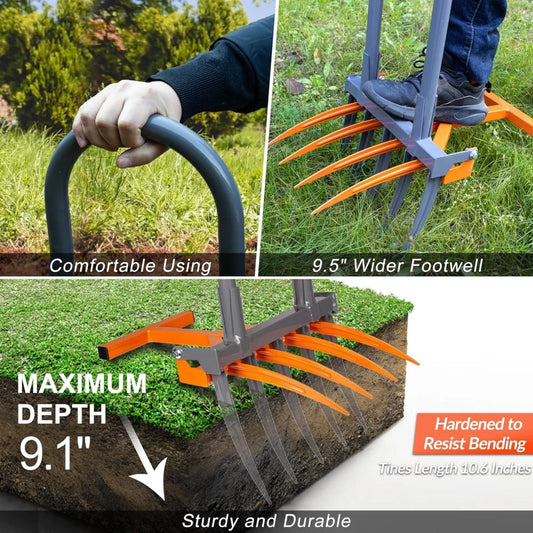
Broadfork Buying Guide: What to Look for Before You Buy
Share
A broadfork can be a useful tool for loosening compacted soil, preparing raised beds, and supporting reduced-till or no-till gardening. But not every broadfork fits every garden.
Before buying one, it helps to understand your soil type, garden size, bed layout, and how you plan to use the tool. This broadfork buying guide explains what to look for before choosing one.
Start with Your Main Garden Problem
Different gardeners need a broadfork for different reasons. Some want to loosen compacted vegetable beds. Others want to refresh raised beds or reduce reliance on a powered tiller.
Ask yourself:
- Is my soil compacted?
- Do I garden in raised beds?
- Do I want a no-till or reduced-till routine?
- Is my soil clay-heavy, sandy, or loamy?
- How large are my planting areas?
Check Tine Count
Tine count affects working width and soil contact. A 9-tine broadfork can cover a wider strip than a narrow fork, which can be useful for garden beds and vegetable rows.
More tines can be helpful for working across beds, but the best choice depends on soil condition and user comfort.
Look at Tine Strength and Length
The tines are the part that enters the soil, so strength matters. Heavy or compacted soil needs a tool that feels sturdy enough for repeated use.
Check product details for tine material, construction, and intended use. Avoid forcing any broadfork through extremely rocky, wet, or impossible soil.
Consider Handle Design
Handle design affects control. A U-shaped handle can allow two-handed leverage during repeated soil-loosening motions.
The handle should feel stable and suitable for the way you work through garden beds. For more detail, read U-Shaped Handle Broadfork: Why Handle Design Matters.
Think About Working Width
Working width matters if you have raised beds, vegetable rows, or defined planting areas. A wider broadfork can help cover more ground per pass, but it may also require more effort in dense soil.
If your beds are narrow or your soil is very heavy, consider how much width you can comfortably manage.
Match the Tool to Your Soil Type
Soil type affects how a broadfork feels in use. Loamy soil is easier to loosen. Clay soil may require more patience and better timing. Rocky soil can be difficult for any tine-based tool.
If your soil is clay-heavy, read how to improve clay soil in a home garden.
Decide Whether You Need a Broadfork, Garden Fork, or Tiller
A broadfork is not the only soil tool. A garden fork may be better for small digging jobs. A tiller may be faster for large or new areas. A broadfork is often best for established beds, reduced-till soil preparation, and compacted garden beds.
For more comparison, read broadfork vs garden fork and broadfork vs tiller.
Check Weight and Storage
A broadfork should be sturdy enough for soil work but still manageable to move, store, and use. Think about where you will keep it between gardening sessions.
Storage areas may include:
- Garage wall hooks
- Garden shed
- Utility room
- Outdoor tool rack under cover
Consider Raised Bed Use
If you garden in raised beds, check that the broadfork width fits your bed layout. A broadfork can help refresh raised bed soil without turning the entire bed over.
For a raised bed workflow, read how to prepare raised beds without turning the soil.
Where the Homiva Broadfork Fits
The Heavy Duty 9-Tine Broad Fork Garden Tool with U-Shaped Handle is designed for gardeners who want a manual soil preparation tool for compacted garden beds, raised beds, and vegetable planting areas.
It may be a good fit if you want a broad working width, 9-tine design, U-shaped handle, and a manual alternative to powered tilling for established beds.
Helpful Related Guides
- What is a 9-tine broadfork?
- Heavy duty broadfork benefits
- U-shaped handle broadfork
- Common soil preparation mistakes
Broadfork Buying Checklist
| Feature | What to Check |
|---|---|
| Tine count | Working width and soil contact |
| Tine strength | Suitability for compacted soil |
| Handle design | Control and leverage |
| Soil type | Clay, loam, sand, or rocky soil |
| Garden size | Raised beds, rows, or larger plots |
| Storage | Where the tool will be kept |
| Use case | No-till, soil prep, bed refreshing, or compacted soil |
Common Buying Mistakes
- Choosing only by price
- Ignoring soil type
- Buying a tool too wide for the bed layout
- Expecting a broadfork to replace every soil tool
- Using it when soil is too wet
- Forgetting about storage space
Frequently Asked Questions
What should I look for in a broadfork?
Look at tine count, tine strength, handle design, working width, soil type, garden size, and how easy the tool is to store.
Is a 9-tine broadfork better?
A 9-tine broadfork can cover a wider working area, which may be useful for garden beds and rows. The best choice depends on your soil and comfort level.
Can a broadfork replace a tiller?
For many established garden beds, a broadfork can be a practical alternative. For large new areas, a tiller may still be faster.
Is a broadfork good for clay soil?
It can help loosen clay-heavy soil when the soil is workable, but clay improvement also needs compost, mulch, and careful moisture management.
Should I use a broadfork every season?
Use it when beds need loosening. Some beds may need seasonal loosening; others may improve enough with compost, mulch, and reduced foot traffic.
Final Thoughts
A good broadfork should fit your garden beds, soil type, and soil preparation goals. Focus on tine count, handle design, working width, strength, storage, and realistic use.
To explore a heavy duty 9-tine option, view the Heavy Duty 9-Tine Broad Fork Garden Tool with U-Shaped Handle.